
Somalia’s High School Certificate System
Somalia’s High School Certificate System (HSC)
Somalia’s High School Certificate System (HSC) transformed a slow and paper-based process into a fast, fully digital public service. By integrating GovStack’s modular building blocks for registration, identity verification, payments, and digital registries, the government created a seamless system that allows students to apply for, pay for, and receive verified certificates online. The new approach has reduced delays, lowered costs, and improved access for thousands of students across the country, especially those in rural and underserved areas.
The starting point: Slow and manual process
The process of getting a verified high school certificate in Somalia was slow, manual, and inefficient. Students had to travel long distances to government offices, wait weeks or even months for stamps and signatures and depend on paper-based certificates and manual verification processes
The main people affected were high school graduates across Somalia, especially rural students. With around 170,000 students enrolling in secondary schools every year, the problem affected very large numbers of young people.
This mattered because the delays directly impacted students’ futures and life opportunities. A student could loose a scholarship because their certificate arrived too late and Someone from a poor or remote area might not afford repeated travel costs. Delayed certificates could postpone university admission or employment
The solution: Modular digital system
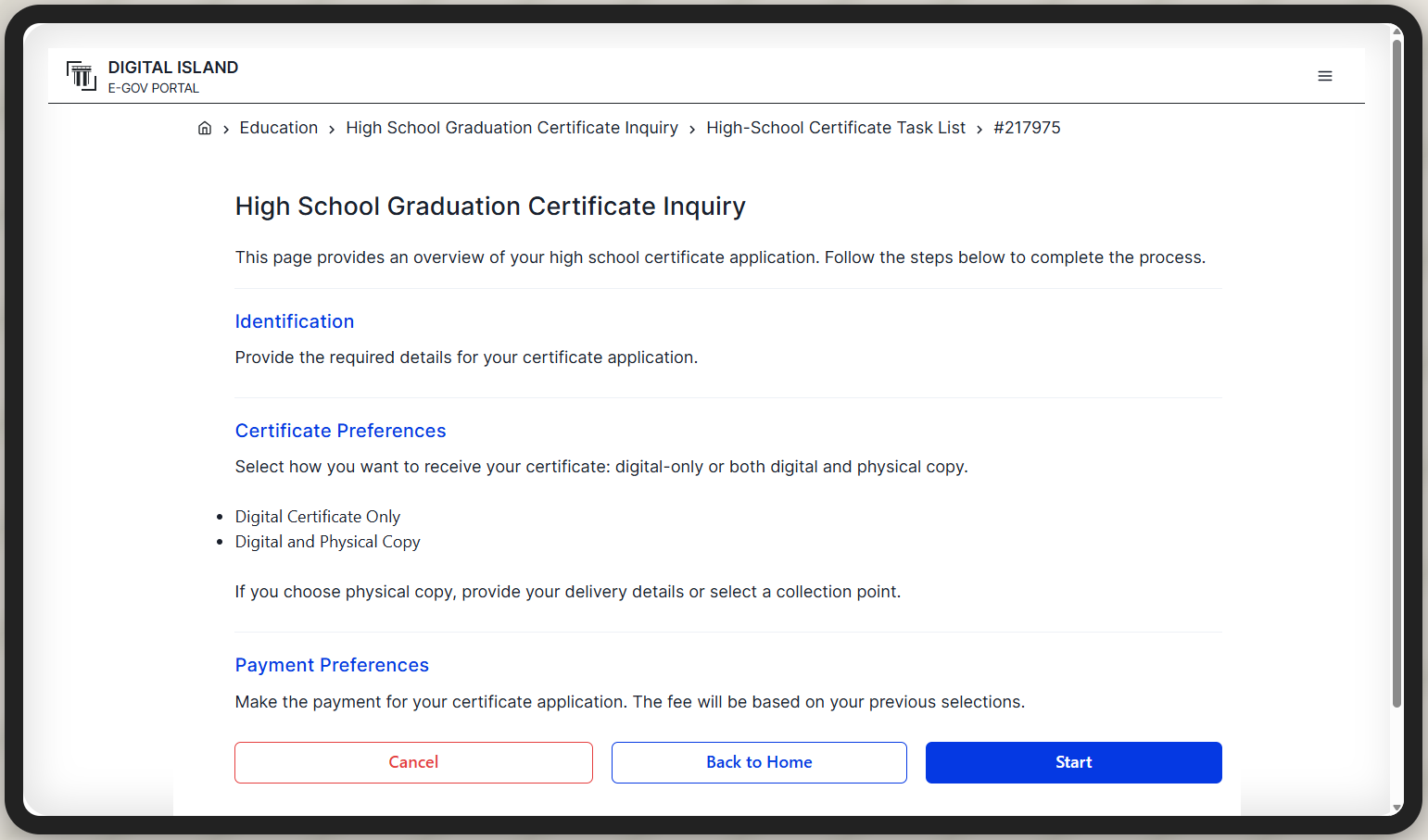
The government of Somalia built the High School Certificate System (HSC), a digital platform that modernized how high school certificates are issued and verified. The HSC service enables high school students to access verifiable digital certificates through the HSC portal. Before the services, students had to travel long distances and wait weeks – sometimes months – to get a stamp and a signature on their certificates. With the launch of the High School Certificate System (HSC) (or access a public prototype on our demonstration environment), students can now apply for their certificates online, securely pay fees, and receive a verified digital certificate instantly – all without the need for long trips or manual paperwork.
For High School Certificate System (HSC), GovStack integrates predefined open and interoperable building blocks, including Registration, Identity Verification, and Consent (eAqoonsi NIRA ID), Payments (SomaliPay and GovPay) and Digital Registries (MOECHE Examination System).These building blocks enabled Somalia governments to build HSC service faster and more efficiently through a modular and reusable approach instead of developing new systems from scratch.
The HSC system integrated several GovStack building blocks, including:
- Registration → for student application and enrollment processes
- Identity Verification and Consent → through the eAqoonsi and NIRA digital ID systems
- Payments → using SomaliPay and GovPay for secure fee payments
- Digital Registries → connected to the MOECHE Examination System to retrieve exam results automatically
These interoperable components worked together to create one seamless digital service
The GovStack approach made development faster and more efficient because the government did not need to build every system from the scratch.
Now, students can complete the entire certificate process digitally.
The impact: Digital access for 170,000 secondary school students
The new High School Certificate System (HSC) in Somalia improved several important areas:
- Speed: Students no longer wait weeks or months for certificate approval and collection. Verified digital certificates can now be received almost instantly.
- Access: Students, including those in remote and rural areas, can apply online without traveling long distances to government offices.
- Cost: The system reduces transportation expenses, paperwork costs, and administrative workload by digitizing the process.
- Transparency and efficiency: Automated verification and digital records reduce bureaucracy, manual errors, and opportunities for document tampering or fraud.
- Convenience: Students can securely download, print, and share certificates whenever needed.
Around 170,000 secondary school students enroll each year, meaning a large number of learners will benefit from easier certificate access.
The process has shifted from a slow paper-based system to an automated digital platform.
This is meaningful because it directly improves young people’s opportunities and future prospects.
The bigger picture: Reusing for additional services
The High School Certificate System (HSC) is more than a single digital service because it acts as a foundation for broader digital government transformation in Somalia.
The project is not only about issuing school certificates. It demonstrates how government institutions can modernize public services using connected digital systems. The same infrastructure and processes can later support many other services, such as birth certificates and University transcripts
GovStack enables reuse, scalability, and sustainability through its modular “building block” approach.
Instead of building every government service from scratch, GovStack provides reusable digital components that can be combined for different services
Similar case studies

Digital Leaders Spotlight: Djibouti
Djibouti is committed to leveraging digital technology in its public service delivery, including regulatory and policy reforms, as part of its Vision 2035 objectives.
Digital Leaders Spotlight: Kazakhstan
Kazakhstan has been a vocal advocate and a champion of digital transformation in central Asia. Kazakhstan is ranked 28th globally on the UN E-Government index. More than 1,000 different public services are available online and more than 90% of Kazakhstan’s economically active population is using the country’s electronic government platform – e.Gov.


