
Connecting Digital Services Across Government: Jordan’s GovStack Approach

Across the world, governments that successfully digitize services eventually encounter a new question: how can all digital services work together cohesively?
By mid-2026, 85.8% of government services had been digitized, and by September more than 3.25 million digital identities had been activated through the SANAD app, Jordan’s official digital government app.
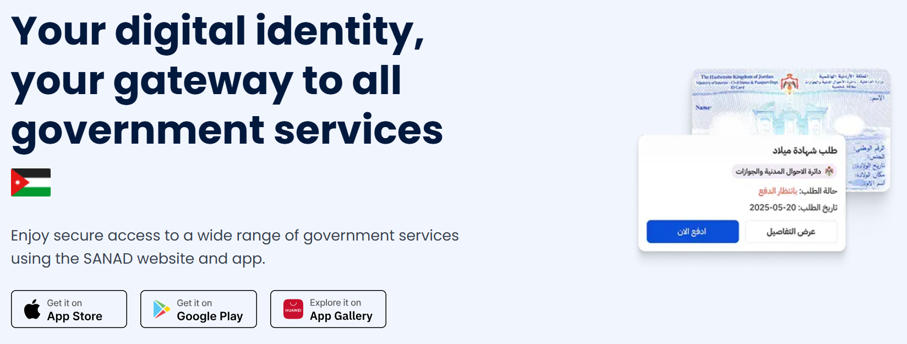
As digital services expanded, differences between institutions became more visible. Like many governments digitizing their services, Jordan’s institutions initially developed individual solutions according to their own requirements. Over time, this resulted in different interfaces, logins and payment methods from one service to the next. Limited connections between the systems also meant that citizens could be asked to provide documents and data another government institution already held.
To address these issues, Jordan developed common national standards for how digital services should be designed, connected, secured and improved. GovStack provided a starting point for this work. This article looks at how Jordan adapted open GovStack references to its existing systems and how the resulting national standards are now being put into practice across government.
Developing common standards for digital services
Making digital services work together required shared approaches to architecture, APIs, interoperability, accessibility, security, privacy, performance and data governance. Jordan used GovStack specifications and its Building Block logic as references for national policy and implementation.
In 2025, a GovStack country mission brought GovStack experts together with the Ministry of Digital Economy and Entrepreneurship and the Digital Transformation Unit at the Prime Ministry. The main value was a tested foundation that Jordan could adapt to its own context.
“GovStack gave Jordan a head start. Instead of writing national standards from scratch, the team could build on proven, open specifications and focus on what makes Jordan’s context unique.”
Following this approach, the selected consortium, GFA Consulting Group and OPTIMIZA, adapted the GovStack references and many other international standards to Jordan. The work produced Digital Services Standards and supported the redesign the frontend of the SANAD app and web portal.
From there, GovStack Building Blocks were ranked according to national priorities. Digital Registries and Identification and Authentication are mandatory. Payments, Consent, Messaging, eSignature, GIS and Workflow are recommended where relevant. These capabilities were then linked to national infrastructure.
The redesigned SANAD interface also became the reference for the national design standard. Together, the standards support one national login, an “ask the citizen once” approach, one payment gateway and more consistent services across government.
Putting the standards into practice through IRTIQA
In September 2026, Jordan launched IRTIQA, the National Digital Transformation Standards Framework, to give government institutions a common way to assess their progress, including how they apply the Digital Services Standards.

At the launch of the national IRTIQA framework, Samira Zoubi, Secretary General of the Ministry of Digital Economy and Entrepreneurship, explained what that progress should mean in practice:
“Digital transformation should no longer be measured by the number of digitized services or systems launched, but by institutions’ ability to use technology and data to simplify procedures, improve performance, and provide more accessible and efficient services.”
As the umbrella framework, IRTIQA assesses institutional digital maturity across 10 domains, 16 dimensions and 34 standards. One of these, standard 9.1.4, requires institutions to comply with the separate set of 16 Digital Services Standards, which define how digital services should be built.
The first assessment cycle covers over 30 government entities. The institutions submit supporting evidence, including process maps, service inventories and approvals for system integrations. It is then rated “compliant”, “partially compliant”, “non-compliant” or “not applicable” for each IRTIQA standard. The results help institutions understand their strengths, identify where they need support and track their progress over time.
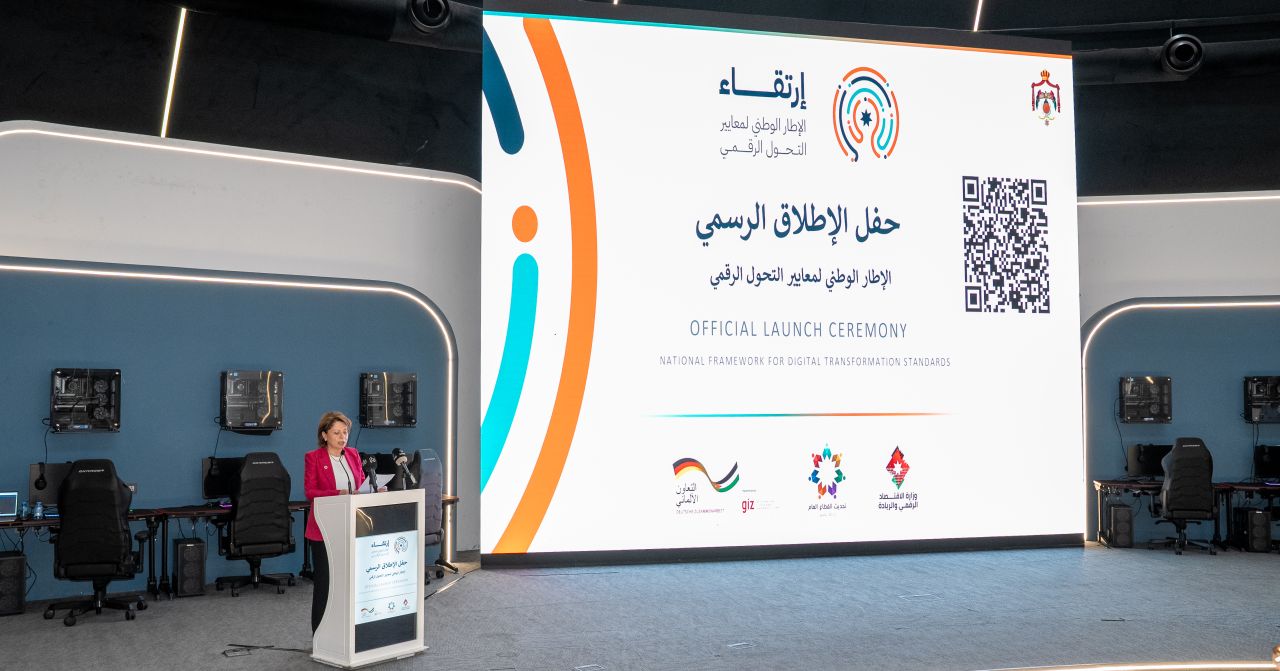
As Minister of State for Public Sector Development H.E. Badriya Balbisi said at the launch:
“We measure today to improve tomorrow.”
For government teams, the standards provide clear expectations: which national platforms to use, which technical and design requirements apply and what evidence is needed. They can also be used in procurement instead of drafting requirements again for every tender.
As institutions apply the standards, services should become easier to recognise and navigate, with better data exchange between authorised institutions and fewer repeated steps. A life event such as registering a birth or marriage should become one connected journey rather than a series of separate administrative processes.
Jordan’s experience shows that GovStack’s open specifications and guides have helped shape national standards, procurement, service design, shared-platform rules and assessment. At the same time, Jordan retained ownership: It prioritized the Building Blocks that fit its needs, mapped them to infrastructure it already operates and integrated them into its own governance framework.

The work was supported by the development project “Improved Governance to Support Jordanian Reform Projects (PARtner I and PARtner II) implemented by GIZ Jordan on behalf of the German Federal Ministry for Economic Cooperation and Development (BMZ), with support of GFA Consulting Group and OPTIMIZA.