
“Build Once, Use Across Government”: Mauritania’s GovStack Journey
When governments digitize public services one by one, the result is not automatically a coherent digital government. Ministries may create separate systems, collect the same information repeatedly and design services that look and work differently. Mauritania is actively working against this fragmentation using GovStack resources. Over the past two years, the country has explored GovStack from several angles: developing an adoption roadmap, prototyping digital services, testing low-code tools and establishing common standards for government architecture and service design.
These activities were delivered through collaborations involving Mauritania’s Ministry of Digital Transformation and Modernization of the Administration (MTNIMA), ITU, GIZ, GovStack experts and private-sector partners. The activities address the underlying question: how can digital government services become part of a coherent system rather than a collection of isolated solutions?
Starting with practical experimentation
Mauritania’s GovStack journey began in 2024, with a series of GovStack trainings delivered with ITU support. The program was intended to develop an adoption roadmap, strengthen knowledge of the GovStack approach and prototype priority public services. Rather than discussing digital architecture only in theory, government teams were given the opportunity to work through the development of an actual service.
In 2025, more than 30 representatives from the Ministries of Justice, Transport, Finance and Digital Transformation joined a five-day workshop with ITU and the Ukrainian GovTech company Kitsoft. Working in teams, participants went through the development cycle for a company-registration service for the National Social Security Fund. They analyzed the existing process, defined the target workflow, created forms and interfaces, configured user roles and notifications, and explored connections with government registries. The work used Kitsoft’s AI-assisted Liquio low-code platform, a solution listed as GovStack compliant on the GovStack market. The workshop showed how government teams can move from a service problem to a functional prototype within a short period and test it.
From individual services to common foundations
A prototype can show what is technically possible. It cannot, on its own, answer how the next service should fit into the wider government landscape. That became the focus of the complementary workstream supported by GIZ’s DIGITAL-Y project. GovStack experts Jeremi Joslin and Stefan Draškić worked with MTNIMA on two connected foundations: A government architecture standard to improve interoperability, security and efficient service development; and a unified service-design approach to make public services more consistent, accessible and user-friendly. The work drew on GovStack’s Architecture Specifications, Service Patterns and Implementation Playbook. The objective was to establish common principles for deciding what should be shared, what can be reused and where something new is genuinely needed.
In March 2026, a national consultation brought together 118 representatives from 34 government departments. Participants agreed on a central approach:
“Aucune administration ne peut digitaliser ses services en vase clos.”
This means, “No public institution can digitize its services in isolation”. The resulting reference framework draws on GovStack and TOGAF. It foresees a national library of reusable digital components and an architecture council responsible for ensuring that future systems follow shared standards.
Under this approach, a ministry planning a new service should first examine what already exists: Can an existing component provide identification, notifications or data exchange? Can it be reused or adapted? Only where no suitable capability is available should something new be developed.
This reflects the practical idea behind GovStack’s Building Block approach: common digital capabilities should become shared government infrastructure rather than being developed again inside every individual service.
Creating consistency for citizens
A coherent digital government requires more than connected backend systems. Its services should also feel as though they come from the same government. The Mauritanian core team and GovStack design expert Stefan Draškić examined existing services and identified recurring interactions, such as identification, completing a form, submitting an application, tracking its progress and receiving a result. These repeatable parts can be documented as service patterns. When teams develop a new service, they do not have to redesigning every interaction from the beginning.
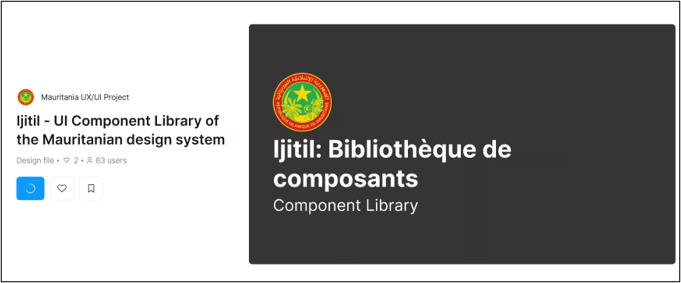
This work informed a UX Charter, a Style Guide and Ijitil, Mauritania’s government design system. Ijitil provides reusable visual and interaction components for public websites and applications. MTNIMA states that the design system is already used internally and is intended to be extended to other ministries. The design system has also been published openly under creative common licence through the Figma Community:
Turning standards into working practice
Architecture frameworks and design systems only create value if the people developing new services know how to use them. From 28 September to 2 October 2026, a five-day workshop in Nouakchott moved the work from formulating standards towards applying them. The program included senior and middle management as well as 120 recently recruited public servants. Sessions addressed technical architecture, user experience, interface design, change management and the redesign of administrative procedures. The final day brought in private-sector participants to discuss interoperability, artificial intelligence and digital public services.
GovStack experts Jeremi Joslin and Stefan Draškić led practical sessions on questions the teams will encounter in their work:
- When should an existing component be reused, and when is a new one necessary?
- How should institutions respond to security incidents?
- How can architecture standards be applied to real projects?
- How can a request for a new online service be translated into a complete, user-friendly process?
- How can Ijitil and shared service patterns create consistency across ministries?
“L’objectif n’est pas seulement d’apprendre les normes, mais aussi de les appliquer dans notre travail quotidien et que le citoyen ressente leur impact sur la qualité des services que nous leur fournissons. ”
Translation : The goal is not only to learn the standards, but also to apply them in our daily work so that citizens can feel their impact on the quality of the services we provide.
The workshop enabled the teams who will make future architecture and design decisions to apply shared standards in their everyday work.
Key Take Aways
Mauritania’s approach brings together two forms of reuse. On the technical side, shared architecture and Building Blocks help institutions reuse common digital capabilities. On the service-design side, Ijitil and service patterns help teams reuse established interactions and interface components.
Mauritania’s journey also shows that GovStack adoption does not need to follow one fixed implementation route. Prototyping helped teams understand what could be built. Architecture and design standards established how individual services could fit together. The latest workshops prepared the people who will be responsible for putting those standards into practice.